Is “Pattie Gonia” parody… or a brand too far?
By Chezanne Haigh | Consultant
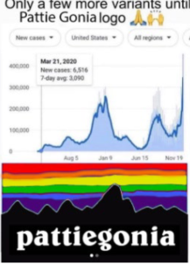
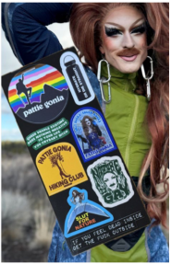 Images from Court Exhibit
There’s something intriguing about the recent dispute between environmental drag artist Pattie Gonia and outdoor apparel giant Patagonia that goes beyond a typical trademark case.
On paper, it looks straightforward. A well-known brand is enforcing its trademark rights against a similar name being used in commerce. That happens all the time.
But in reality, it feels different.
This is not just a dispute about logos or labels. It is about identity, activism and the point at which a joke, a persona or a piece of commentary becomes something more commercial and legally significant.
What actually triggered the dispute?
The tension between Pattie Gonia and Patagonia did not emerge overnight. For several years, the two co-existed without formal litigation, despite the obvious similarity in names.
The shift seemed to happen when Pattie Gonia’s activities moved beyond performance and advocacy into something more structured and commercial. In 2025, she filed a trademark application covering clothing, marketing and related services, and began selling merchandise under the name.
From Patagonia’s perspective, that was a turning point. The company argues that the use of “Pattie Gonia” is a near-copy of its brand and that expanding it into a commercial offering creates a risk of confusion and dilution.
From Pattie Gonia’s side, the framing is entirely different. She has positioned the dispute as something broader than trademark enforcement, arguing that it threatens her identity and the advocacy work built around it.
And so, the dispute quickly moved from a legal disagreement into a public conversation.
A dispute that almost settled, but didn’t
What makes this case particularly interesting is that it nearly resolved before escalating.
Patagonia reportedly offered to drop the lawsuit on fairly focused terms: withdraw the trademark applications, stop using Patagonia-style branding and stop selling merchandise under the Pattie Gonia name.
Crucially, the offer did not aim to stop her from performing or continuing her activism.
Yet, Pattie Gonia rejected the proposal.
From a legal perspective, that might be surprising. As trademark commentary has noted, these are the kinds of settlement terms many courts would likely converge on if the matter proceeded.
From a practical perspective, however, the refusal makes more sense. For Pattie Gonia, the name is not just expressive. It underpins partnerships, fundraising and the broader ecosystem of her work. Removing the commercial element would fundamentally change that model.
What looks like a narrow legal compromise on paper may feel like an existential one in practice.
Why Patagonia may feel it has no choice
It is easy to view this dispute through a moral or reputational lens. A large company pursuing an activist who arguably shares its mission invites criticism.
But trademark law introduces a different logic.
One of the more compelling points raised in public commentary is that trademark owners are expected to enforce their rights consistently. If they do not, they risk weakening those rights over time.
That means companies often act not just because they want to, but because they feel they need to. Failing to act in one case can make it harder to act in the next.
In that context, the Patagonia decision becomes less about targeting a specific individual and more about maintaining the integrity of a brand built over decades.
Parody, infringement… or something in between?
At its core, the Pattie Gonia dispute revolves around a familiar but difficult question in trademark law:
When does parody remain protected expression and when does it cross into infringement?
In many jurisdictions, parody is recognised as a legitimate form of expression. But that protection is not absolute. The more a parody starts to function as a commercial identifier, especially in overlapping markets, the more likely it is to be treated as a competing brand rather than commentary.
That tension is exactly what we are seeing here. “Pattie Gonia” began as a clear play on the Patagonia name, rooted in humour and expression. But as the persona expanded into merchandise, partnerships and trademark registration, the legal character of that use arguably began to shift.
A South African lens: Laugh It Off still resonates
For South African lawyers, this question immediately echoes the Constitutional Court’s decision in Laugh It Off Promotions v SAB.
In that case, a small business parodied the Carling Black Label trademark to make a broader social point. SAB challenged the use, but the Court ultimately sided with the parody creator, emphasising the importance of freedom of expression.
The Court held that trademark rights must be balanced against constitutional values and that a trademark owner must demonstrate real, not speculative, economic harm before limiting that expression.
The judgment is often seen as a powerful endorsement of parody, even where it has a commercial dimension. But it is important to remember what the Court actually did. It did not create a blanket defence for parody. Instead, it required a careful balancing exercise, weighing trademark rights against constitutional values.
Applying that approach to the Pattie Gonia dispute makes for an interesting thought experiment.
On one hand, the argument for parody remains compelling. The name is clearly a pun and the persona carries expressive and activist meaning. On the other hand, the use of the name has evolved beyond commentary into a broader commercial identity, including goods and services that overlap with Patagonia’s own activities.
That shift matters.
Even under the Laugh It Off framework, the key question would likely be whether the use is still primarily expressive or whether it has become a brand in its own right that risks causing tangible harm to the trademark owner.
And that is where the neat distinction between parody and infringement starts to blur.
Where this leaves us
What makes this dispute so compelling is that it does not present a simple right or wrong answer.
Patagonia’s position reflects the internal logic of trademark law and the need for consistent enforcement. Pattie Gonia’s position reflects the realities of modern activism, where identity, expression and commerce are often inseparable.
The law is left to navigate the space between those two positions.
For South African lawyers, the case offers a useful thought experiment. It asks whether the principles established in Laugh It Off are equipped to handle a world in which parody does not just comment on brands but increasingly evolves into brands of its own.
And perhaps that is the real takeaway.
The question is no longer just whether parody should be protected. It is how that protection adapts when parody becomes part of a broader commercial strategy.
Discuss Article with the Author
Recent Articles

Raising a Rule 6(5)(d)(iii) Notice Before the Rule 53 Record: An Irregular Step or a Competent Election?
When does a commercial dispute become an insolvency problem?